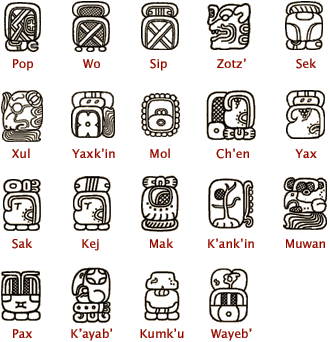
 | 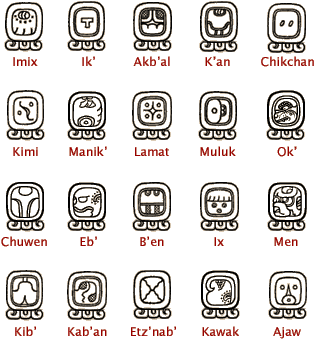 |
The Mayan calender is a combination of all their beliefs. They used their mathematical system in order to accurately calculate every major astronomical event to be used as part of the calendar system. They were able to map out groups of stars, or constellations, to be added in the calendar for astronomical purposes. Also, they were able to to put to use their knowledge of astronomy to calculate the length of a full year. They noticed seasons and were able to accurately predict when each season would arrive and when it would depart onto the next season. They noticed that every 52 years from a certain date that very same date would be exactly the same. According to their calendars there were days during the year when they were lucky and days during the year when they were unlucky. Using their skills the Mayans were able to come up with 3 separate calendars, the jaab' solar calendar, the tzolk'in ritual cycle, and the Long Count calendar-a combination of the first 2 calendars.
The Long Count calendar is a combination of the jaab' and tzolk'in calendars. It is a single 52 year cycle which came about when the Mayans realized that every 52 years certain dates, for example 12 Chikchan 18 Sak, would come around again every 18,980 days, or 52 years. Unlike today's usage of three time units to show a date, the Long Count uses a series of five time units. The following is an example of a Long Count date as would be used by the Mayans and later by modern archeologists with the use of dots:
9 baktun, 3 k'atun, 17 tun, 8 winal, and 11 k'in is written as 9.3.17.8.11
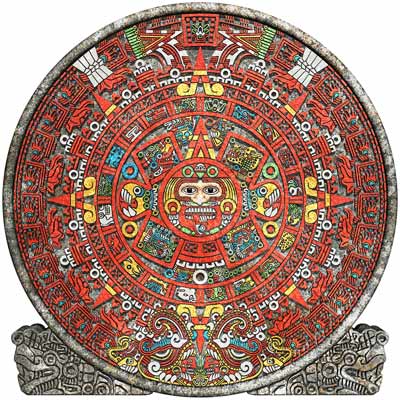 | 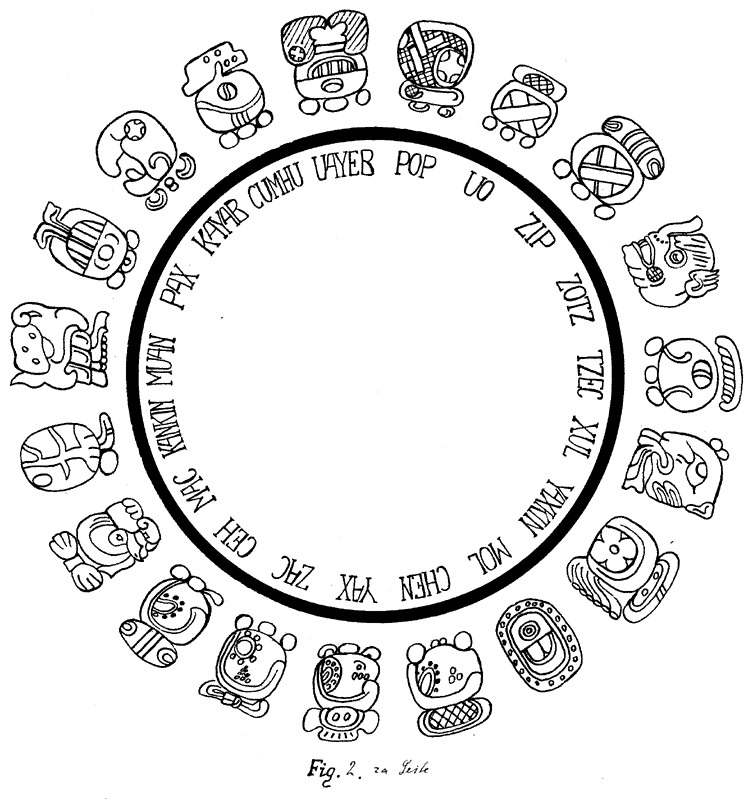 |
